
A company brain gives your team access to the experience behind your best work. When someone sits down to write an article, prepare a proposal, or answer a new employee's question, they can use what the business has already learned without asking you to reconstruct it.
Today, I think building one is no longer optional. I expect more content, more automated outreach, and more opportunities to publish. Your company's perspective will matter more as buyers encounter more of that material. The decisions you've made, the problems you've worked through, and the questions your customers ask give you something specific to contribute.
Much of that knowledge already exists, but it can be hard to use. The objection is in a salesperson's notes, the explanation is in a project manager's email, and the reason you changed an offer may never have been written down. We'd bring the useful material into a shared workspace and maintain the guidance the team needs, with links back to the original sources. AI can then use that material when helping someone prepare their work.
Here's how we'd approach this for an ERP consultancy, software company, or specialist service business, starting with content and following the knowledge into sales, delivery, and onboarding.
What a company brain does for your business
It's knowledge management, organized so your team and the AI tools they use can draw on it. Here's what that does for each part of the business:
- Content: Drafts start from real customer questions, the delivery team's checked explanations, and approved examples of your voice.
- Audience research: Topic and channel decisions rest on where your buyers actually look for answers, beyond where the team happens to enjoy posting.
- Sales: Comparing calls with your discovery guidance shows what was missed before the next conversation.
- Offers: The reasoning behind the current offer and the results of past work are available when someone prepares a proposal.
- Delivery: Support tickets and project notes show where the offer needs attention and who owns the next action.
- Onboarding: New hires get the current offer, customer context, and the reasons behind decisions without the founder explaining it all again.
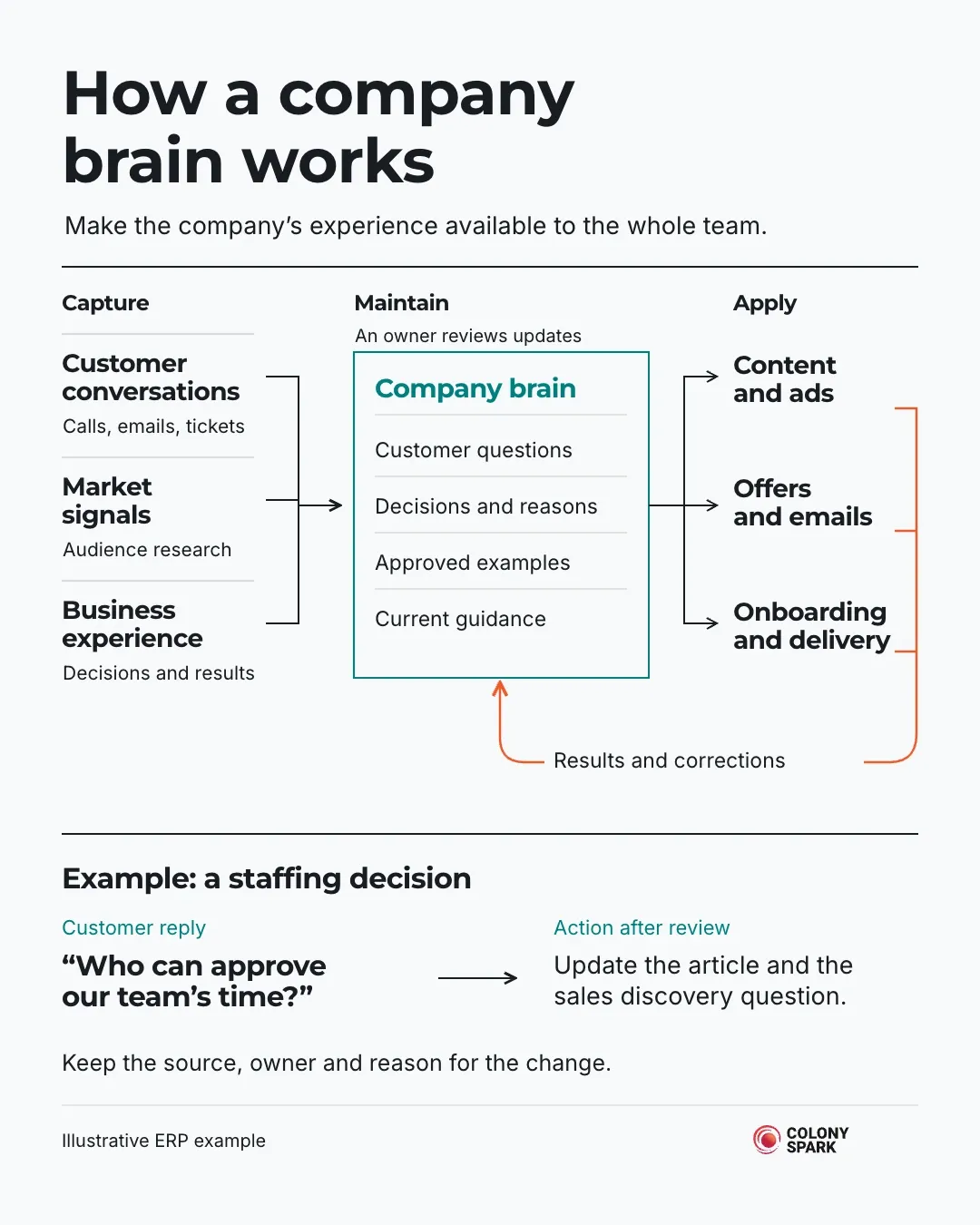 New information is reviewed before it changes the guidance the team works from, and results flow back as updates.
What founders need to prepare: Shared knowledge, contributions and review, AI access, reusable skills, and a first assignment.
Follow a customer question into the next piece of content
Say an ERP consultancy keeps hearing that prospects are worried about how much time implementation will take from their employees. The salesperson has answered this on calls, and the delivery team has explained it in onboarding materials. Those sources give us a much better starting point for an article than a general prompt about ERP implementation.
We'd read the conversations alongside the project notes to understand the concern. Data cleanup, training, and project decisions require different people and different kinds of preparation. An article about employee workload needs to explain those differences. The delivery team can check the explanation before sales sends it to a prospect.
That material also gives us a focused LinkedIn post about who needs to be involved in implementation. We can test an ad around staff availability, using the same checked explanation on the page it leads to.
Before drafting, we'd give the AI a clear assignment: explain the customer's workload concern, use the delivery team's checked material, and identify anything the sources don't answer. The brief would include the audience, the decision the piece should help with, and approved writing examples. We'd ask for an outline with supporting sources first. A confident paragraph about an unanswered question would come back for correction.
Voice needs more than a few adjectives such as "direct" or "conversational." We'd preserve examples of how you explain a difficult decision, edits you've made to drafts, and wording you avoid. A new writer or assistant could see both an approved passage and why an earlier version was changed. If you consistently remove a phrase or change how a service is described, we'd preserve that correction and its reason. The team would still review the draft for substance and whether it sounds like you.
Now suppose the prospect reads the article and replies that the hours aren't the main problem. They need someone to approve time away from normal duties. That changes what we'd do next. Sales needs to understand who can make that decision, and marketing has a missing part of the explanation to address.
A follow-up email could say:
You mentioned that approval for your team's time is the unresolved issue. Before we put together a project schedule, could we include the person who approves that time? We can walk through the work your team would own and what they need to decide.
We'd add that response to the record and update the article brief. The next draft would explain the staffing decision as well as the work involved. This is why content results belong in the company brain: replies, questions, sales feedback, and the kinds of prospects an ad attracts can tell us what the initial piece missed. Views and clicks help describe distribution; we'd also want to know whether the material helped the intended customer understand a decision.
Decide where that explanation belongs
An article can answer the right question and still reach very few of the people who need it. We'd keep audience research alongside the customer knowledge so topic and distribution decisions have a basis beyond where the team happens to enjoy posting.
That includes the publications customers read, people they follow on LinkedIn, podcasts they listen to, YouTube channels they watch, and communities they consult on Reddit or elsewhere. We'd also collect what they search for on Google and the kinds of questions they tell us they bring to AI tools. A customer telling us where they found an answer is different evidence from a search-volume estimate or an AI-generated suggestion. We'd keep those distinctions and the sources visible.
If the consultancy's customers rely on a specialist's implementation videos, we have a reason to explore a demonstration or interview. A trade publication they repeatedly mention deserves a closer look before we recommend a placement. Marketing results then help us assess those choices. Audience research needs to stay connected to the people we reach and the responses we receive.
We'd organize those findings by buyer role and situation. Someone researching a first implementation may need different material from an operations leader replacing a system. For each useful source, we'd record who mentioned it, what they used it for, when we learned that, and what remains uncertain. A podcast with a large audience may have little relevance to the customers we're trying to reach.
The team could then ask, "Where do prospects go when they're trying to understand implementation workload, and which questions haven't we answered?" That gives us a reason to choose a topic and format. It also leaves room to revise the recommendation when customer behavior changes. We wouldn't treat a list of popular channels, or an AI-generated list of presumed interests, as proof of where our buyers spend time.
See what's missing before the next sales conversation
Sales coaching needs the customer conversations as well as the company's current discovery guidance. A call may contain a thorough explanation of features while leaving the implementation owner unidentified. Comparing the call with the team's discovery guidance makes that omission easier to spot. Across won, lost, and stalled deals, we'd investigate what buyers needed before deciding, which communications received useful responses, and where the team kept leaving questions unanswered. Those records won't capture every interaction or prove that a particular article caused a sale, but they can show us what to investigate in the next conversation.
For a deal review, we'd bring together the discovery notes, emails, proposal versions, material sent to the buyer, and the reasons given for delays. The account record would distinguish an email we sent from something the buyer confirmed they read. If we don't know what they saw, that stays unknown.
An AI-assisted review could organize the open questions before the next call:
- What problem has the buyer confirmed, and what are we still assuming?
- Who needs to participate in the decision, and have we spoken with them?
- Which commitments have we made, and what information do we still owe them?
- What did the buyer say after receiving our explanation or proposal?
The salesperson would check the review against the actual conversation. In the staffing example, the useful coaching is specific: we explained the workload but didn't establish who could approve employees' time. That gives the rep something to resolve on the next call. Comparing similar opportunities later may reveal a recurring discovery gap, which we'd add to the team's guidance.
Use past work to prepare and explain an offer
An offer can change because of what delivery learns. We'd keep that reasoning with the current offer so the next person can explain it. Suppose the consultancy used to include data cleanup in a standard implementation scope, then found that customers' source data varied too much to price the work reliably. It now requires a data review before agreeing to that part of the scope.
A salesperson preparing a proposal can find the review requirement and explain it to the prospect. The accompanying email can connect it to what came up in discovery. Delivery can see what was agreed, what the customer still needs to provide, and any commitments sales made before kickoff. When someone joins the company later, that decision record explains why the offer works this way. They don't have to discover the issue by repeating the old promise.
A new opportunity may call for work that isn't in the standard offer. For a separate example, say we're helping a warehouse software company with a prospect that wants to improve inventory accuracy but isn't ready for a wider implementation. We'd help its team examine relevant past scopes, discovery notes, delivery requirements, and documented results. A focused assessment may fit, provided the team checks the conditions that made similar work useful, the new customer's situation, and current capacity and costs. The proposal can explain what the customer will receive and why that work makes sense. Past success informs the choice; it doesn't guarantee the next result.
The comparison needs more than a successful proposal to copy. We'd want to know what problem the earlier customer had, what they supplied, what the team delivered, which parts required more effort than expected, and how the result was assessed. An assessment completed with clean data and an available customer team may be a poor reference for a prospect that has neither.
From that review, we'd prepare a proposed scope with the deliverables, customer responsibilities, exclusions, and questions still to resolve. The email introducing it could connect the recommendation directly to discovery: "You said you're not ready to commit to a wider implementation. We'd suggest starting with an inventory assessment so your team can decide which problems need attention first." Delivery would check the proposed work before sales commits to it. The company brain helps the team make that judgment with relevant history available.
Connect customer problems to the work you agreed to deliver
After work begins, support tickets and project notes can reveal where the offer needs attention. If customers keep requesting a configuration step that wasn't included, the team needs to look at the requests and the time spent delivering them. We might need to clarify onboarding, change the scope, improve the product, or price additional work separately. Keeping those findings available helps the founder see which offers are useful to customers and sustainable to deliver.
Customer conversations also belong here after the initial project. An unresolved problem needs an owner. A request for help with another part of the business may warrant an expansion conversation. We'd record what the customer actually asked for, so an internal sales idea doesn't become mistaken for demand.
For example, repeated requests for help with a report might point to an unclear handoff, an unresolved defect, or a useful additional service. We'd read the tickets alongside the agreed scope and the team's delivery notes before recommending a response. The account owner would have a short record of the issue, its status, what was promised, and who is responsible for the next action. Suppose the report was included and works as intended, but the handoff never explained how to use it. Delivery could add that explanation to the onboarding material and support could use it in the next response. We'd then check whether later customers still need the same help. A request for a different report would remain a separate scope question.
That record also gives the founder a way to investigate margin problems. We'd compare recorded effort and scope changes with what the project allowed for, using the actual project records. If that information is missing, we'd identify what needs to be collected. AI shouldn't fill the gap with a plausible estimate and present it as a project result.
Give new teammates the background to make good decisions
A new hire needs a useful way into this history. We'd give them a role-specific starting page with the current offer, relevant customer context, approved examples, working procedures, and the decisions they're allowed to make. The source material would be available when they need to understand an answer in more depth.
For a salesperson joining the ERP consultancy, that starting page would explain the data-review requirement from the earlier example. It would link to the current scope language, the decision that introduced it, and an approved explanation for prospects. An older proposal that included data cleanup would be marked as historical. Otherwise, the new hire could find a persuasive example and repeat a promise the business has deliberately stopped making.
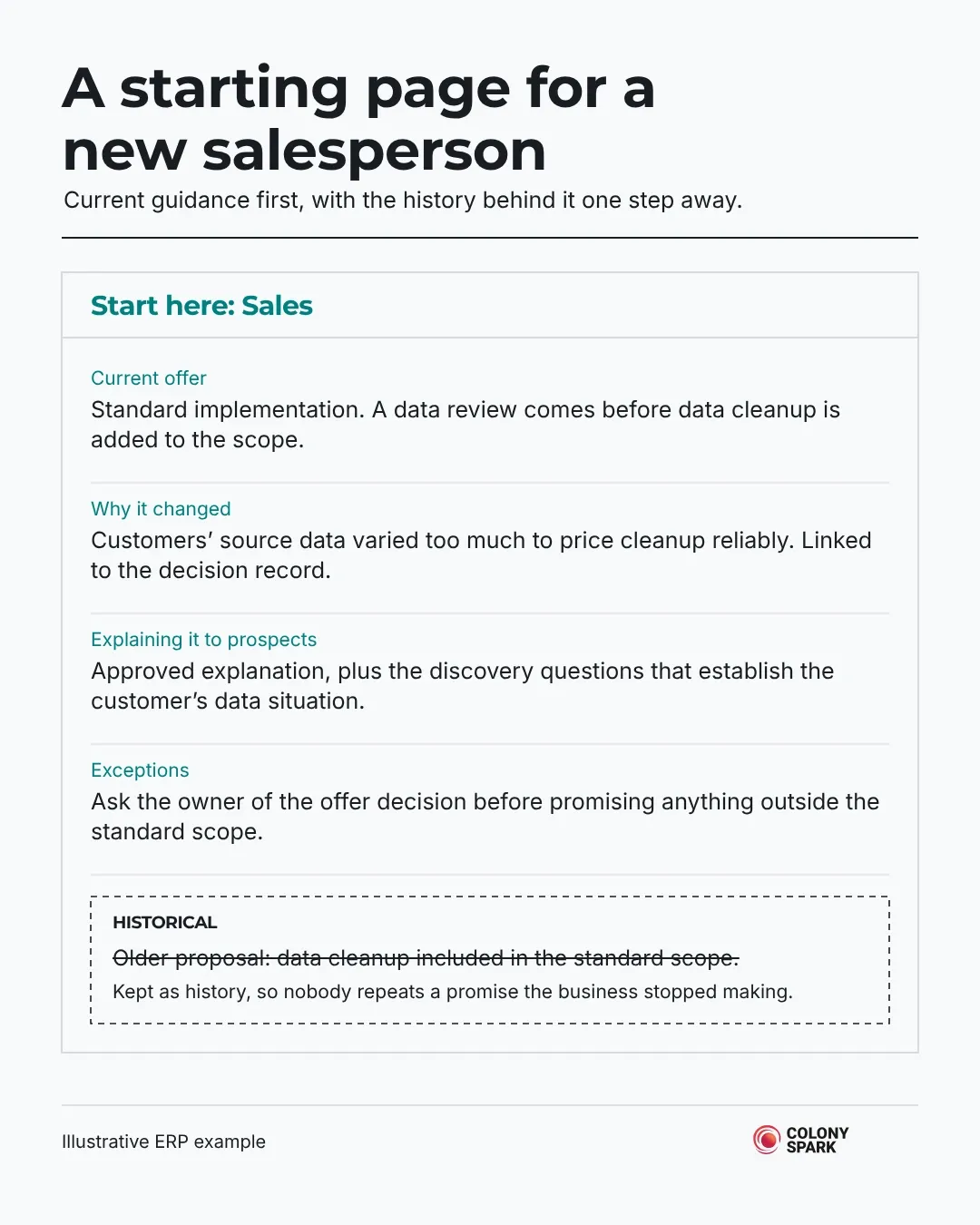 What a new salesperson would see first, with the old promise kept as history.
They could ask the company brain why the requirement exists, which discovery questions help establish the customer's situation, and who can approve an exception. The answer should point to the current decision and its owner. A question without a reliable answer becomes something to resolve with the team, rather than something the assistant invents to finish the response.
We'd then give the new salesperson a sample opportunity to work through with their manager. Can they find the current scope, explain the requirement, and recognize when an exception needs approval? Their questions show us where the onboarding material is incomplete. We'd add those explanations so the next hire benefits from the same review.
This works for existing teammates too. A marketer can understand why an offer is positioned a particular way. An account manager can find customer commitments without reconstructing an email thread. The founder still owns consequential decisions, but colleagues can handle agreed work and bring better-prepared questions when a decision needs attention.
Before someone changes roles or leaves, we'd review their open commitments, recurring exceptions, and undocumented judgments. A short conversation about a difficult recent project can reveal reasoning that a folder of finished work doesn't contain. Everyone contributes to this history, including the people who discover its gaps while using it.
What we'd bring together
We'd begin in a shared workspace the team already knows how to use. Inside it, the team needs to distinguish original material, current guidance, and work produced from that guidance. A call transcript preserves what was said. A reviewed note explains what the business learned. An article or proposal applies that knowledge to a particular job. Keeping those distinctions visible makes it easier to trace an answer and update the right place when something changes.
The starting documents would explain who the company serves, the problems it helps with, its current offers, and how responsibilities are assigned. We'd include approved positioning and voice examples, along with relevant working procedures. Those documents give new customer information context: a question from a poor-fit prospect shouldn't automatically redefine the offer.
The exact tool matters less at this stage than whether people can find current guidance, follow its sources, and contribute something useful after doing their work.
| Material | What we'd preserve |
|---|---|
| Company context | Customers we serve, positioning, current offers, responsibilities, and approved voice examples |
| Sales calls, customer calls, emails, and roundtables | Questions, objections, commitments, account context, and what remains unresolved |
| Projects and support tickets | Delivery requirements, recurring issues, changes in scope, and what the team learned |
| Marketing work and results | Articles, LinkedIn posts, ads, audience response, useful replies, and feedback from sales |
| Audience research | Search questions, publications, communities, podcasts, videos, people followed, and the basis for each finding |
| Decisions, offers, and working practices | What changed, why, who owns it, approved examples, and onboarding guidance |
| New material awaiting review | Incoming notes and records that haven't yet been checked or incorporated |
A simple folder layout could use Start here, Customers and opportunities, Audience and market, Offers and delivery, Content and results, Decisions and procedures, and Inbox for review. We'd organize customer material by account and keep dates in the records. The starting page would point people to the current guidance for their work, so they wouldn't need to learn the whole folder structure before using it.
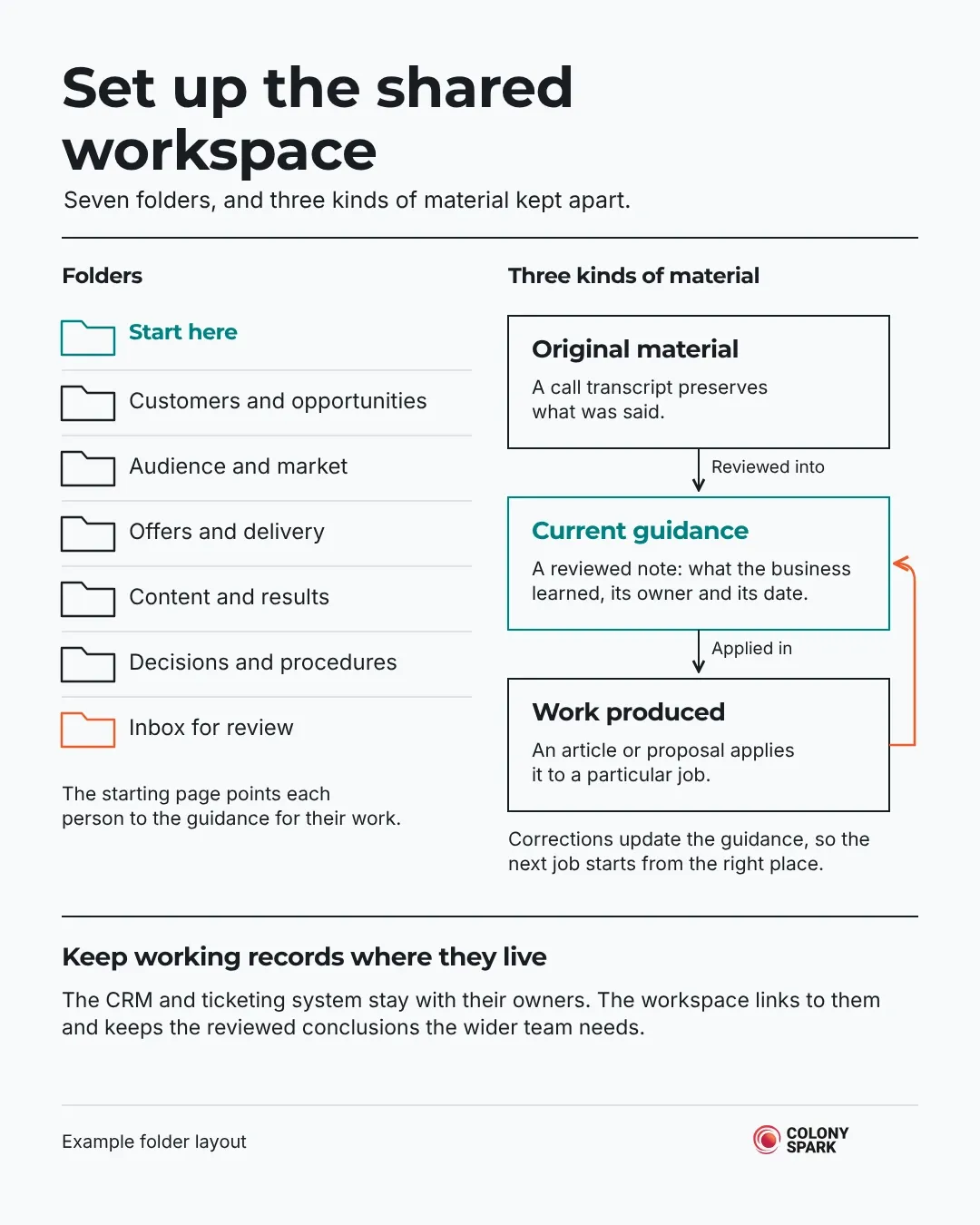 The folder layout, and the three kinds of material the team keeps apart.
A shared folder with those sections can be enough to start. We'd give current guidance an owner and a date, and keep superseded material identifiable as history. Access needs to reflect the information involved; a shared company brain doesn't mean every customer record is open to everyone. A general lesson about scoping can be useful across the business while the customer's detailed commercial information stays restricted.
We wouldn't move the whole CRM or ticketing system into this folder. Those systems should continue to hold the working records their owners maintain. The shared knowledge can link to them and preserve the reviewed conclusions the wider team needs. If a link is inaccessible or a copied record has become stale, the owner needs to resolve that before it supports an answer.
Some of the most useful input may come from outside formal meetings. After a small event or conference, a short voice note on your phone can capture what people were talking about and what it made you reconsider. If you're recording the conversation itself, get the participants' permission. Keep exact words, your summary, and your interpretation distinguishable.
Review what changed, then update the work
Collecting new material is part of everyone's job. Someone also has to decide what it changes. We'd make contribution a small part of existing work: add the source and what mattered after a useful call, record the reasoning when a decision changes, and attach audience and date context to marketing results. A weekly review gives the relevant owners a place to resolve contradictions and update current guidance.
After a useful conversation, we'd ask the contributor to leave the source link, the account or topic, what changed, and any action or uncertainty. A note might say: "The prospect is comfortable with the estimated workload but hasn't secured approval for employees' time. Confirm who owns that decision before we propose the schedule." That is easier for a reviewer to use than a transcript with no explanation of why it matters.
The person reviewing customer questions might be in sales; delivery should own technical explanations and implementation commitments. Marketing would maintain content and audience findings. In a small company, one person may hold several of these responsibilities. We'd still name the owner so an item doesn't remain unreviewed because everyone assumed someone else would handle it.
During the weekly review, AI could group related notes, identify possible conflicts, and suggest which current documents need attention. The owner would check whether repeated notes describe separate customer experiences or several records of the same conversation. A recurring issue can justify investigation, but repetition alone doesn't establish its cause.
For the ERP staffing question, the record we'd want to review is quite specific:
| Field | Illustrative entry |
|---|---|
| Customer question | Who approves the time employees need away from normal duties during implementation? |
| Sources | The sales-call note, delivery checklist, and prospect's follow-up email, with dates |
| Interpretation to check | The buyer needs an internal staffing decision as well as an estimate of hours. |
| Proposed changes | Add the approval question to discovery and explain the staffing decision in the article. |
| Review owners | Delivery checks the explanation; sales confirms the interpretation with the buyer. |
AI can help prepare entries like this and connect them to existing material. Here's an instruction we'd use with the week's sources:
Review the new material provided for this week. Identify customer questions, changes in audience behavior, delivery issues, and results relevant to our current work. Link each finding to its source and date. Separate direct evidence from your interpretation. Show contradictions and missing information. Propose updates to our guidance, content ideas, and follow-up actions. Do not overwrite an existing decision or treat a suggestion as approved.
The review owner works through those proposals with the people who understand the source. In this example, sales needs to confirm the interpretation with the prospect. Delivery checks whether the proposed explanation is accurate. Once those checks are complete, we'd update the discovery guidance and content brief, retaining the reason for the change.
We'd also record the review date, owner, status, and the material the update replaces. A new ticket doesn't automatically overturn a decision. It might describe an exception or a situation the existing guidance already covers. If sales and delivery disagree, we'd keep the conflict visible and assign someone to resolve it. The assistant should be able to report that disagreement rather than quietly choose whichever document it finds first.
After an update, we'd check the work that depends on it. A changed scope might require a proposal template, onboarding checklist, and sales explanation to change together. Someone using an older version needs to be able to find its replacement. This is the part of synthesis that makes collection worthwhile: the reviewed information changes what the team uses next.
A calendar reminder is enough to establish the routine. An AI task can support it where the tools and access allow; we'd verify that it can read the intended sources and produce a reviewable result before relying on it.
Make sure AI can use the right information
Putting files in a folder doesn't automatically make them available to an assistant. We'd provide the relevant material through an approved upload or connection, check which files it can reach, and establish how updates become available. If the setup uses uploaded copies, someone needs to replace them when guidance changes. A connected folder still needs its access and update behavior checked.
Before relying on answers, we'd test questions whose answers the team already knows. We'd ask the assistant to explain why the offer requires a data review, identify the current scope, and summarize what a particular customer asked us to clarify. We'd check its responses against the sources and dates, including whether it missed a newer decision.
We'd also ask a question the records don't answer and one where the records disagree. The useful response identifies the gap or conflict and directs the person to an owner. Fluent wording isn't enough to establish that the underlying answer is sound.
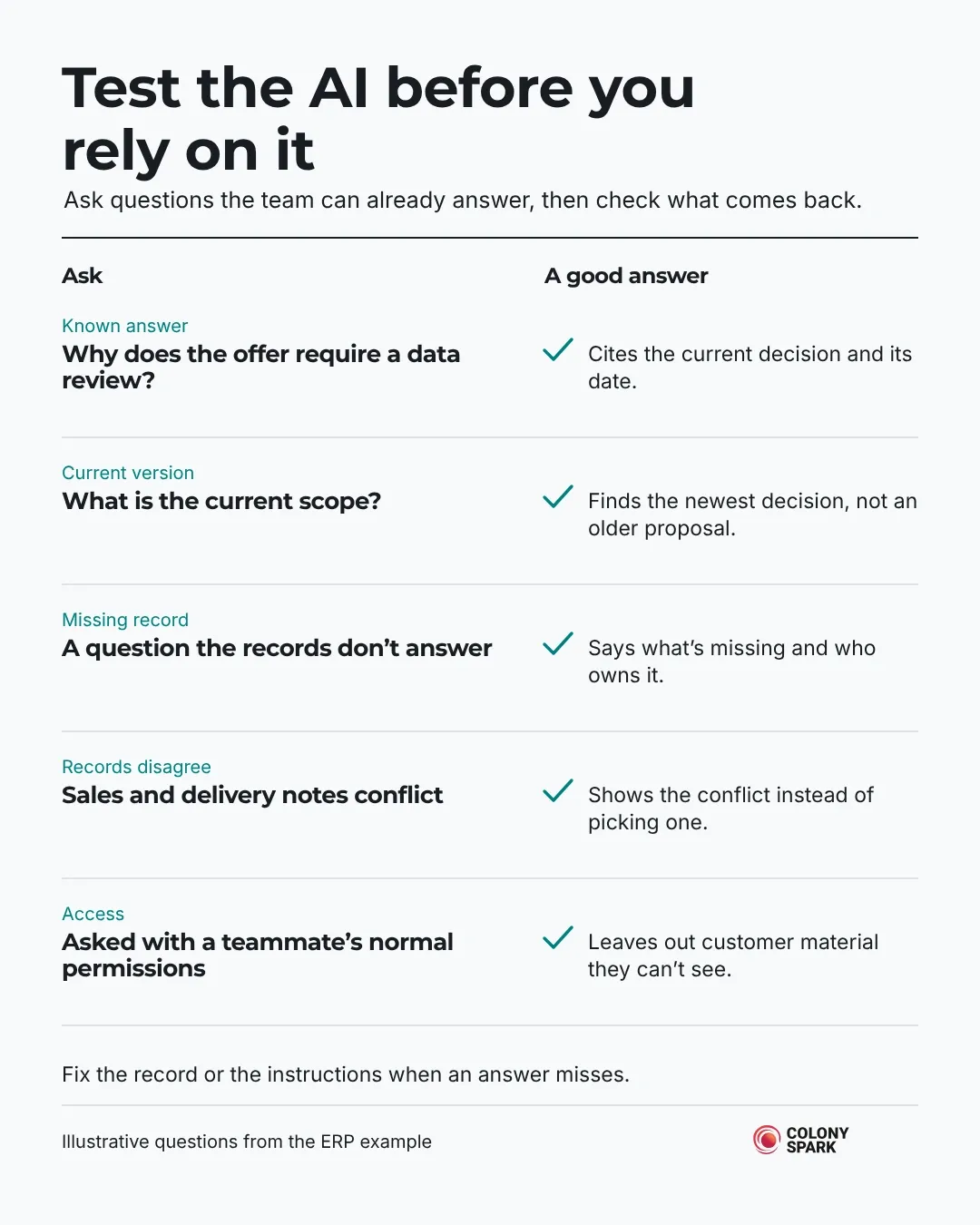 Questions to run before relying on the assistant, and what a good answer does.
Access should follow the person's role. A team member using an AI assistant shouldn't gain access to private customer material simply because the assistant can search a larger collection. We'd test the setup with the permissions people will actually use. For public content, we'd supply approved examples and remove customer details that aren't intended for publication.
Turn useful processes into work the team can repeat
Once a workflow is useful, we'd document the instructions needed to repeat it. That's what we mean here by an AI skill: directions for a particular job, including the material to consult, the decisions to check, and the output someone needs to review.
A proposal skill could read the current opportunity notes, compare relevant past work, and prepare a proposed scope. Its instructions would require it to list missing information and flag commitments that need delivery approval. A content skill could turn reviewed customer questions into a brief, using the audience research and approved voice examples. The source material changes as the company learns; the instructions explain how to use it.
We'd test the process on ordinary work and on a case where the information is incomplete. If the proposal draft keeps borrowing irrelevant past work, we'd correct how the skill selects examples. If it follows an outdated scope because the current decision is hard to find, we'd fix the knowledge record. Saving the final corrected draft alone wouldn't address either cause.
The same approach could support a small internal tool that prepares an account briefing or collects material for a new hire. We'd build that around a task the team already understands and a reviewer who knows what a useful result looks like. Automation becomes easier to assess when its inputs, expected output, and review responsibilities are explicit.
Start with the next assignment
I'd choose work the team already needs to complete, such as the implementation article. We wouldn't need a complete archive before beginning. The first useful set could include the relevant customer conversations, current offer, delivery explanation, and approved writing examples. We'd put them in the shared workspace, name an owner, and agree when the team will review what comes back.
We'd use those sources to create a checked explanation and give sales something useful to send. The prospect's response would tell us what to clarify next.
That first assignment also shows where the company brain needs work: a missing source, an outdated offer, a question nobody has answered, or a decision still sitting only in the founder's head. We'd capture and resolve those gaps as we use it.
To assess progress, we'd look at whether colleagues can find current answers, how much background the founder still has to supply, and which proposal mistakes delivery has to correct. We'd also keep track of unanswered customer questions. Comparing those observations with how the task worked before gives us a way to judge the effort, without assuming every improvement came from the company brain.
If nobody uses the material, we'd look at whether it answers the questions people actually have and is available where they work. If the weekly review produces summaries but no decisions or updated guidance, we'd change that routine. Adding more files wouldn't solve either problem.
The next assignment should begin with the relevant knowledge already available. A teammate can use it, identify what's missing, and contribute a correction. Over time, that gives the business a current record of how it works and why, which people can use to create content, serve customers, and make decisions without reconstructing the history each time.
Frequently asked questions
What should go into a company brain first?
Sales and customer calls, emails, project notes, support tickets, marketing results, audience research, and the reasons behind your offer decisions. Start with the material tied to work the team already needs to finish, such as the next article or proposal.
Do we need new software to build one?
No. A shared workspace your team already uses is enough to start. Keep the original records in the systems that own them and link to them. Before relying on your AI assistant, check that it can read the material and cite an answer the team already knows.
How does a company brain help sales?
Comparing calls with your discovery guidance shows what was missed, like an implementation owner nobody identified. Keeping the reasoning behind offer changes lets salespeople explain them. Looking across won, lost, and stalled deals shows what buyers needed before they decided.
How does it help onboarding?
New hires get a starting page for their role with the current offer, relevant customer context, approved examples, and the decisions they're allowed to make. The reasons behind those decisions are linked, so they don't have to ask the founder to explain it all again.
How often should it be reviewed?
Weekly. Everyone adds what they learn as part of their normal work, and the weekly review is where owners resolve contradictions and update current guidance.